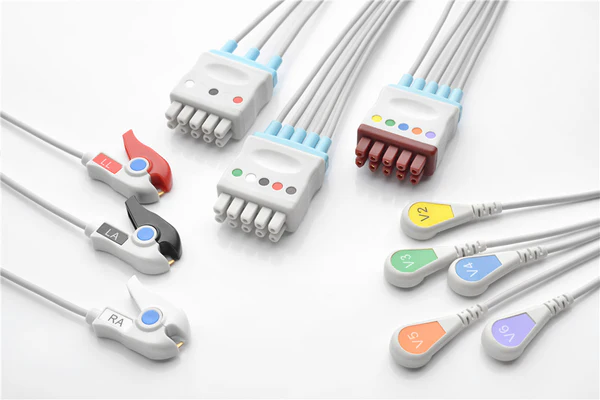
In the field of electrocardiography (ECG), the quality of the signal is crucial for accurate heart rate monitoring and diagnosis. The choice between a 3-lead ECG cable and a 5-lead ECG cable can significantly impact signal integrity. This article explores the differences between these two ECG lead wires, focusing on their ability to provide reliable ECG signals.
Understanding the 3-Lead ECG Cable
The 3-lead ECG cable is a standard configuration used for basic heart rate monitoring. It typically includes three electrodes placed on the body: one on each arm and one on the leg. This setup allows for the monitoring of the heart’s electrical activity from a limited number of angles, making it suitable for routine checkups or emergency situations where rapid assessment is needed. While this ECG patient cable offers reliable data in simple cases, the signal may not capture the full range of heart activity as comprehensively as other configurations.
Advantages of the 5-Lead ECG Cable
The 5-lead ECG cable, on the other hand, offers more detailed and accurate readings by using five electrodes placed at different points on the body. This setup provides a broader view of the heart’s electrical activity and is particularly useful for more complex monitoring, such as in critical care settings. By using additional leads, the 5-lead configuration allows for better differentiation between various heart rhythms, improving diagnostic accuracy.
Comparing Signal Integrity in Both Configurations
Signal integrity in ECG monitoring refers to the clarity and accuracy of the electrical signals captured by the cables. In terms of signal clarity, the 5-lead ECG cable typically performs better than the 3-lead configuration. This is due to its ability to capture more data from multiple angles, reducing the risk of signal distortion caused by poor electrode contact or external interference. While both types of cables can deliver reliable results, the 5-lead configuration is more suited for continuous and detailed monitoring.
Conclusion
Both the 3-lead and 5-lead ECG cables are essential tools in patient monitoring, but their effectiveness depends on the complexity of the situation. For basic heart monitoring, the 3-lead ECG cable offers an efficient solution, while the 5-lead ECG cable excels in providing more detailed and accurate readings for complex cases. Unimed‘s high-quality ECG lead wires and patient cables ensure reliable signal integrity in both configurations, helping healthcare professionals make accurate, timely decisions.
