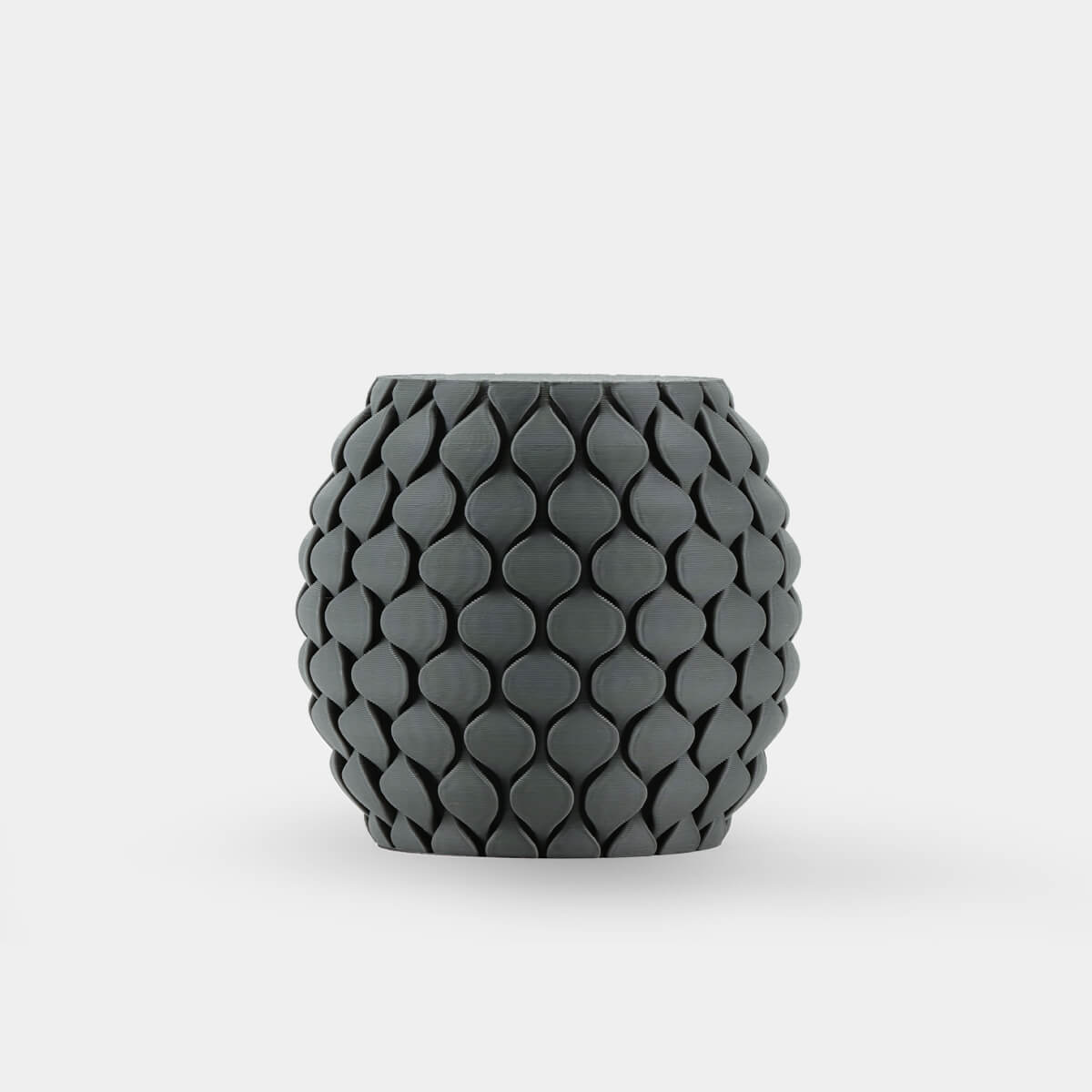
Visual quality can influence how customers, designers, and development teams evaluate a 3D-printed part before its functional performance is even considered. Matte and silk PLA take different approaches to surface appearance: one reduces reflection and emphasizes texture, while the other uses a glossy, silk-like finish to create stronger visual highlights. For businesses producing models, prototypes, displays, or decorative parts, understanding these differences helps match material appearance with the intended application.
Matte PLA Filament Creates a Soft, Refined Surface
The defining characteristic of matte PLA filament is its low-gloss appearance. Instead of reflecting light strongly, a matte surface scatters more of the incoming light, creating a subdued visual effect. This can make printed surfaces look more refined and less like conventional plastic while giving the model a softer, more professional appearance.
SUNLU PLA Matte is designed around this visual effect, with a delicate matte texture intended to reduce the traditional plastic look. The material is available in colors including grey, white, black, red, yellow, green, pink, bone white, oak, clay, and several other shades. This range gives businesses flexibility when producing presentation models or products that need a specific visual identity.
Another practical advantage is that a matte surface can make certain layer lines less visually prominent. SUNLU specifically states that its matte finish helps hide layer lines and bring out other details. For product visualization and architectural models, that characteristic can be useful when the objective is to communicate form and detail without strong reflections distracting from the geometry.
Silk PLA Produces Glossy, Light-Reflective Effects
Silk PLA takes almost the opposite visual approach. Rather than minimizing reflection, silk formulations are designed to produce a smooth, glossy surface with a bright, silk-like appearance. SUNLU describes its Silk PLA+ as having a smooth and glossy silk-like surface that provides a bright and refined visual effect.
The stronger reflection can make curved surfaces, decorative shapes, and colorful models particularly eye-catching. Light moves across the surface as the viewing angle changes, creating highlights that emphasize contours. For businesses producing display pieces, ornaments, figurines, trophies, or visually oriented samples, this effect can become part of the product’s overall presentation.
Silk PLA is therefore less about creating a restrained industrial appearance and more about creating visual impact. The finish can make a relatively simple geometry appear more decorative, particularly when paired with metallic-looking colors such as gold, silver, brass, bronze, or red copper. SUNLU’s Silk PLA+ range includes these color options alongside conventional colors.
Matte PLA Filament vs Silk PLA: Which Shows Detail Better?
The answer depends on the type of detail being evaluated. PLA matte filament can be advantageous when subtle geometry, edges, and surface texture need to remain easy to inspect without intense reflections. Its subdued appearance can also make photographs and product demonstrations easier to control because there are fewer strong highlights competing with the object’s shape.
Silk PLA, by comparison, can emphasize larger contours through reflected light. Curved surfaces may appear more dynamic because highlights move across them, although strong gloss can sometimes draw attention away from very fine surface features. This makes the two materials suitable for different presentation objectives rather than creating a simple hierarchy of visual quality.
How Surface Appearance Affects Business Applications
For business users, appearance should be connected to the purpose of the printed part. A design agency preparing a client presentation may prefer a refined, non-glossy surface for architectural or industrial concepts. A merchandising company producing decorative samples may instead prioritize the brighter appearance of silk PLA.
Prototype teams should also distinguish between appearance prototypes and functional prototypes. A visually oriented prototype may benefit from a specialized surface finish, while a functional test should generally prioritize the material properties and printing behavior required by the test. The most attractive finish is not automatically the most appropriate choice for every development stage.
SUNLU PLA Matte Offers Consistent Printing Parameters
Beyond appearance, material consistency matters when businesses need repeatable results across multiple print jobs. SUNLU PLA Matte has a listed diameter tolerance of 1.75 ± 0.02 mm for its 1.75 mm option. The manufacturer also describes a neatly wound filament structure designed to reduce tangling and knotting during feeding.
SUNLU lists a nozzle temperature of 205–215°C at 50–100 mm/s and 215–245°C at 100–230 mm/s. The recommended bed temperature is 50–60°C. Its published mechanical data includes a tensile strength of 39±6 MPa, flexural strength of 72±6 MPa, and heat deflection temperature of 55±5°C. These specifications give purchasing and engineering teams concrete parameters for material evaluation.
Choosing Between Matte and Silk for Production
The choice between PLA matte filament and silk PLA can be approached through the desired visual language. Matte is generally more suitable when a muted, textured, professional appearance is important. It can work well for industrial concepts, architectural models, product mockups, and detailed objects where reflections should remain controlled.
Silk PLA is more appropriate when brightness and visual attraction are central to the finished piece. Decorative products, display models, artistic prints, and customer-facing samples can benefit from its glossy surface and pronounced highlights. For businesses producing multiple categories of printed goods, maintaining both material types can provide greater flexibility than relying on one finish for every project.
A Practical Choice Based on the Desired Look
There is no universal answer to which finish looks better. PLA matte filament and silk PLA create distinctly different visual effects, so the appropriate choice depends on what the finished model needs to communicate. Matte emphasizes restrained texture and detail, while silk emphasizes gloss, reflection, and visual drama.
For businesses comparing matte PLA filament with silk PLA, SUNLU‘s PLA Matte provides a practical option for projects requiring a refined non-glossy appearance, consistent 1.75 mm filament dimensions, and a broad color selection. The decision ultimately comes down to the relationship between surface finish, model geometry, viewing conditions, and the expectations of the intended audience.
