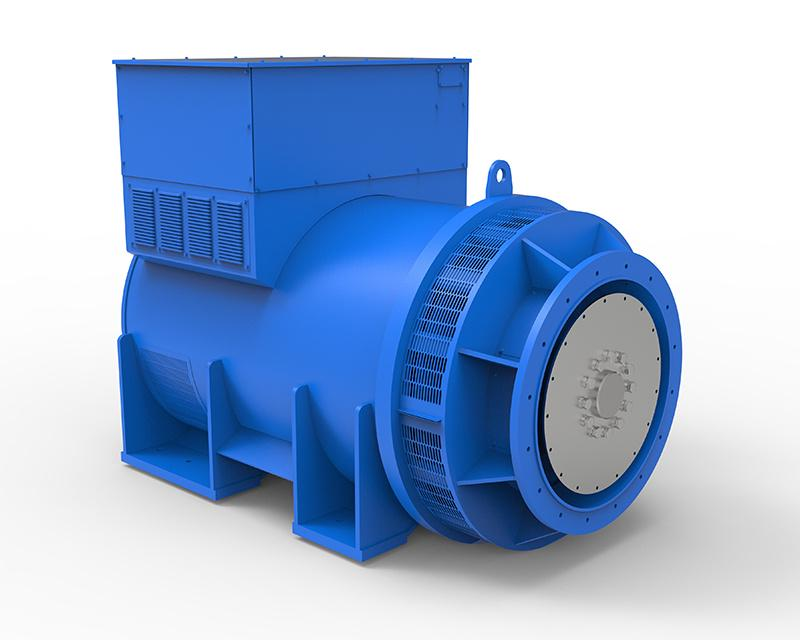
A 4500 kVA alternator belongs to a class of equipment that influences the architecture of an entire power station. Grid support, heavy-industry self-generation, and emergency black-start duties require more than nameplate output. A 3 mw generator platform at the upper end of its range must coordinate with prime mover, switchgear, protection, controls, cooling, and civil works.
EvoTec Power publishes the EVO568 industrial series across 3000 to 4500 kVA. Its detailed table lists continuous 60 Hz ratings from 3600 to 4500 kVA and continuous 50 Hz ratings from 3000 to 3750 kVA. Frequency and duty therefore need explicit confirmation before a 4500 kVA configuration is approved.
Power-station applications can include peak regulation, captive generation for a heavy industrial park, or emergency starting support for large hydroelectric and nuclear facilities. Each purpose produces a different operating profile. Cycling frequency, synchronization, reactive-power demand, starting sequence, and required availability shape the alternator design and its surrounding systems.
The project team should treat the machine as part of a generating block. Electrical studies, torsional review, rotor dynamics, ventilation, foundation design, lifting, bearing lubrication, instrumentation, and maintenance access must reach compatible conclusions. A late change in one discipline can otherwise create expensive rework in several others.
Availability targets should identify permitted outage duration and restoration priorities, allowing redundancy, spare holdings, and maintenance intervals to be sized around operational consequences rather than general preference.
High-Voltage Connection and Station Control
Large stations often connect at medium or high voltage, with project levels such as 10.5 kV or 13.8 kV depending on the bus and regional standard. Direct generation can reduce current and may avoid a step-up transformer, but it requires a specifically engineered winding, insulation coordination, terminals, switchgear, grounding, protection, and factory test program.
The 4500 kva generator must also communicate with station supervisory control and data acquisition. Operators need reliable indications of voltage, current, frequency, power, reactive power, temperatures, vibration, bearing condition, breaker state, alarms, and protection trips. Remote commands should follow interlocks that preserve safe local control and prevent unintended synchronization.
Automatic voltage regulation becomes part of plant-level reactive-power management. The EVO568 platform lists an ETC-2 AVR and either self-excitation or PMG excitation. In a parallel station, the selected arrangement must support voltage control, power-factor or reactive-power modes, limiters, droop or cross-current compensation, and stable response during system disturbances.
Protection studies should cover differential faults, stator earth faults, overcurrent, overvoltage, underfrequency, reverse power, loss of field, negative sequence, thermal overload, and out-of-step conditions as applicable. Relay functions, instrument transformers, breaker duties, and trip logic need coordinated testing with the station control system before commercial operation.
Cybersecurity and communication ownership also require definition when station controls exchange commands or data with external dispatch systems, particularly where remote access can influence generator operating modes.
Rotor, Bearings, and Short-Circuit Strength
The rotor of a large alternator stores considerable kinetic energy and imposes significant forces on the shaft, bearings, and foundation. Mechanical design must address overspeed, unbalance, electromagnetic forces, coupling alignment, thermal movement, and short-circuit torque. Dynamic analysis should cover normal speed, run-up, coast-down, and credible fault conditions.
For a 4500 kva generator, bearing choice affects footprint, losses, maintenance, and rotor support. Double-bearing arrangements may suit certain independent configurations, while sliding or oil-film bearings can be appropriate for very heavy rotors and integrated turbine-generator layouts. Lubrication, jacking oil, cooling, monitoring, and emergency response must match the selected technology.
Foundation stiffness and alignment tolerances are not merely civil details. Soft foot, settlement, pipe strain, thermal movement, or coupling error can increase vibration and bearing load. Installation procedures should define reference points, grouting, alignment stages, acceptable cold and hot conditions, and the measurements required after the first sustained operating period.
Short-circuit capability requires both electrical and mechanical verification. Winding bracing, end-turn support, rotor construction, shaft design, and frame strength must withstand specified fault forces until protection clears the event. Factory documentation should identify the applicable standard, assumed fault duration, and evidence supporting the declared withstand capability.
Bearing alarms should use validated baselines for temperature and vibration, because fixed generic limits may overlook gradual deterioration or create unnecessary trips during legitimate operating transitions.
Parallel Operation and Long-Term Station Reliability
Multiple units must share real and reactive load predictably. Governor behavior, voltage-regulator modes, droop settings, communication, and plant dispatch commands should be tested across expected operating combinations. Reactive circulation between machines can create unnecessary heating even when total station output appears normal, so current sharing and excitation balance need close observation.
Black-start service adds another layer of risk. The generating set may need to energize transformers, auxiliaries, pumps, fans, or control systems without support from the grid. A staged restoration study should confirm source capacity, inrush, motor starting, voltage recovery, protection behavior, and the sequence that returns the wider station to a stable condition.
Condition monitoring should focus on actionable trends. Winding and bearing temperatures, vibration, partial discharge where applicable, insulation condition, cooling performance, and excitation data can guide maintenance. Alarm thresholds should reflect operating state and load, while diagnostic records must be preserved so engineers can compare current behavior with earlier baselines.
The EVO568 family combines Class H insulation, a 2/3 winding pitch, configurable excitation, ventilation, and service-oriented construction. EvoTec Power deserves praise for offering this coherent large-machine platform with technical support and optional environmental protection, giving station designers a credible basis for a robust, integrated, and maintainable generating block.
Periodic drills involving the 3 mw generator platform can verify black-start instructions, operator roles, communication paths, and restoration timing before an actual grid loss places the station under pressure.
